The only AI-native end to end grading solution

From question paper tograded overnight.verified in hours.AI or human marking.published with confidence.

Design rubrics with an AI co-pilot, evaluate papers with AI or human examiners, and publish verified results — all in one platform. AI evaluation or on-screen marking, your choice. Live at institutions with 20,000+ students.

10×
faster than manual
99%
OCR accuracy
20K+
students evaluated
Sharda UniversitySharda University
300papers/hour
99%OCR accuracy
DPDPA Compliant
NIUNoida International University
DPIIT#startupindia
Microsoft for Startups
10×faster grading
20K+students evaluated
Sharda UniversitySharda University
300papers/hour
99%OCR accuracy
DPDPA Compliant
NIUNoida International University
DPIIT#startupindia
Microsoft for Startups
10×faster grading
20K+students evaluated
5 stages, fully automated

One platform. The complete examination lifecycle.

From uploading the question paper to publishing student results — everything happens here, with AI at every step.

1

Design the rubric with AI

Upload the question paper. AI extracts sections, questions and parts — including Bloom's taxonomy tags and multi-modal questions. Refine model answers and scoring criteria in the co-pilot workspace. Freeze a version-controlled rubric when you're ready.

AI extractionCo-pilotVersion control
2

Upload answer sheets

Connect Google Drive, S3, or upload locally. Any handwriting style, any booklet format — calibrated via the booklet profile studio for exact answer-region detection.

Google DriveAmazon S3Local
3

AI evaluates — 5-stage pipeline

Gemini reads the handwriting, detects strike-throughs and rough work. Claude scores each answer against the rubric and emits a feedback note and annotated PDF — under a minute per paper.

OCR → Normalize
→ Resolve → Score
→ Annotate
4

Review & adjust with the grading co-pilot

Give natural-language commands — fix a model answer, re-grade with partial credit, flag a paper. The co-pilot proposes a before/after diff you accept or discard. Anonymous IDs are revealed only at publish.

5

Publish results & export

Release validated results to students. Export scorecards as PDF, push marks to your analytics dashboard, or deliver via API — with a full audit trail throughout.

✦ AI Grading Co-pilot

Don't just get suggestions. Give commands.

The grading co-pilot understands your rubric, sees every answer, and takes real actions. Ask it anything in plain English — it proposes a concrete before/after change you accept or discard. No prompt engineering. No context-switching.

"Fix Q2's model answer for a variable-density rod" — it rewrites the derivation and shows you the diff
"Balance the scoring on Q9" — it adds the missing component so marks reconcile to max
"Re-score Q7 with partial credit for the correct DFS" — updates the score, adds a feedback note
"Draft the missing model answer for Q3" — elastic/inelastic contrast written in seconds
Grading co-pilot
Rubric Designer · PHY201
Fix Q2's model answer — the derivation should be for a variable-density rod, not a thin uniform one
Q2's current answer derives I = ML²/12 for a uniform rod. Here's the general form for variable density λ(x) — I'll update the model answer and mark the derivation as applying to the student's given λ.
Proposed changeQ02 · Model answer
Current
I = Σmᵢrᵢ². For a thin rod (λ = M/L): I = ML²/12 about the centre.
Suggested
I = ∫₀ᴸ x²·λ(x) dx where λ(x) is the given linear density. Evaluate for the specific λ(x) stated in the question; reduces to ML²/3 at the end or ML²/12 at the centre for uniform λ.
Accept change
Discard
Balance scoring on Q9, draft missing answer for Q3…
Rubric Designer

Design better rubrics, faster

The AI co-pilot extracts structure from your question paper, helps author model answers and scoring criteria, and flags inconsistencies before you freeze the rubric — all in a live three-pane workspace.

Bloom's taxonomy auto-classification — every question tagged and visualized across the paper
Per-part scoring with live tally validation — know immediately when components don't sum to max marks
Multi-modal questions — diagrams, sketches and figures supported as expected answer components
Version-controlled frozen rubrics — older versions persist for historical evaluation runs
See the rubric designer →
rubric.qdemy.ai
Q
Qdemy by QverLabs
Rubric DesignerReady for review
PHY201 · Engineering Physics
72/ 84m
✦ Co-pilot
Freeze
Outline
Q01
State the work-energy theorem…
Q02
Define moment of inertia…
Q03
Elastic & inelastic collisions…
B · Long Answer
Q06
Rotational dynamics…
Q07
Kepler's laws…
Question status
7 Ready2 Review2 Missing
Bloom distribution
RecallApplyH.O.
Q01State and explain the work-energy theorem, illustrating with one everyday exampleReady4m
Q02Define moment of inertia. Derive for a thin uniform rod of mass M and length LReview4m
InfoSpecify the rod is uniform (λ = M/L) to make the derivation unambiguous.
Accept
Dismiss
Model answer
I = Σmᵢrᵢ². For a thin rod (λ = M/L) about its centre: I = ML²/12.
Q03Distinguish between elastic and inelastic collisions, giving one example of eachIncomplete
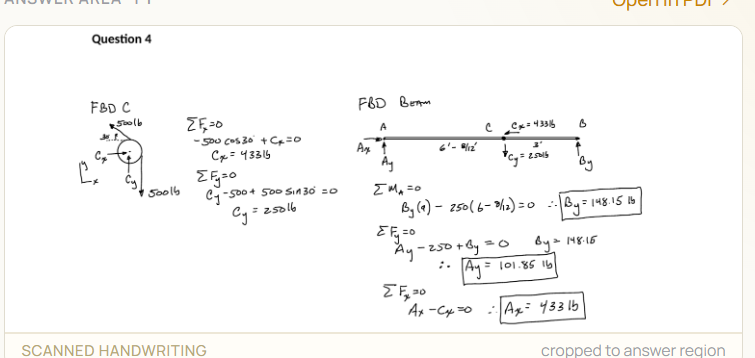
Scanned handwritingcropped to answer region
Scanned handwritten answer — FBD C and FBD Beam force analysis
Transcribed text
FBD C
Fx = 0
−500 cos 30° + Cx = 0
Cx = 433 lb
Fy = 0
Cy − 500 + 500 sin 30° = 0
Cy = 250 lb
FBD BEAM
MA = 0
By(9) − 250(6 − 8/12) = 0
By = 148.15 lb
Fy = 0
Ay − 250 + By = 0  ∴ Ay = 101.85 lb
Fx = 0
AxCx = 0  ∴ Ax = 433 lb
Handwriting Recognition

Every pen stroke, precisely understood

Qdemy's OCR pipeline reads any handwriting style — from messy field equations to multilingual scripts — and produces a verified transcription aligned to your rubric. Every answer region is isolated, every crossed-out edit detected.

Evaluator feedback
Excellent work. You correctly analyzed the forces at the pulley and applied the equilibrium equations to the beam, taking into account the specific dimensions given in the figure.
Criteria applied
Cable tension & FBD
Correctly identified cable tension and drew FBDs.
3/3
Resolution of inclined cable force
Correctly resolved the inclined force at C.
3/3
∑Fx = 0 and Ax
Correctly applied sum of forces in x.
2/2
Moment equation
Correctly applied moment equation considering pulley radius.
3/3
∑Fy = 0 and final reactions
Correctly applied sum of forces in y to find final reactions.
3/3
Raw 14 · γ-adjusted to 14✦ Re-score with assistant
7aThese are various physiological changes during emotion.
- Chest tightening
Shaking
Sweating
feeling dizzy
nausea
hyperventilation
Weakness.
headaches
Stomachaches.
All those are physiological changes that take place during various states of emotions. When angry one might feel their chest tightening, or fear they might feel sweating, shaking etc.
Q7
?
3.5/5
Feedback Q7

Q7: (a) You correctly identified several physiological changes, such as hyperventilation, sweating, and shaking, but missed key cardiovascular and digestive system responses.

(b) Unanswered (optional — not counted toward total).

PDFStudent_AnonID_Q3847 · Page 4 of 7 · PHY201
Student Feedback

Every student gets a fully annotated result

After evaluation, every student receives an annotated PDF of their own answer sheet — with per-question scores stamped directly on the page, detailed feedback notes, and scoring justification. No black boxes.

Score stamps on the answer itself — each question scored inline so students see exactly where marks were awarded or deducted
Per-question feedback notes — plain-English explanation of what was correct, what was missed, and why
Criteria-level transparency — students see which rubric criteria were met, partial, or missed for every sub-question
Anonymity preserved until publish — student identities are revealed only when results are officially released
LaTeX · Diagrams · Graphics

STEM-grade content, natively

From partial derivatives to circuit diagrams — the rubric designer and evaluator handle typeset mathematics and annotated figures without any conversion step.

LaTeX in rubrics & model answers — render equations inline in every scoring component; the AI reads them at evaluation time
Diagram & figure annotation — label regions of scanned figures; the evaluator checks student drawings against annotated reference diagrams
Graph & chart recognition — axes, curves and data points detected from handwritten answers; partial marks for correct structure
Equation matching — evaluate algebraic equivalence, not just surface similarity; 2x² = 8 scores the same as x² = 4
PhysicsMathematicsEngineeringChemistry
Q06Moment of a force about a line
READY
22m
2 parts☐ 2 figuresdiagramscored
Figures
xyzOABFC60°
Force F directed from point A to point B, and vector C
3'3'3'ABP100 Fyxz
Force of 100 lb acting along the diagonal of a box
Q#  6ANSWER  2of 2 parts
Model answer

First find the unit vector along F. AB = (7−9, 5−3, 11−6) = (−2, 2, 5) with |AB| = √(4+4+25) = √33, so F = 1000√33(−2, 2, 5) ≈ (−348.16, 348.16, 870.39) N. Use position vector from any point on line C (the origin) to a point on the line of action, r = OA = (9, 3, 6) m. The moment about O is MO = r × F:

MO =ijk936−348348870= (522, −9923, 4178) N·m

The unit vector along C is uC = (cos 60°, sin 60°, 0) = (0.5, 0.866, 0). Hence MC = MO · uC = 0.5(522) + 0.866(−9923) + 0 ≈ −8332 N·m. The magnitude of the moment about line C is about 8.33 × 10³ N·m (negative sign indicates the sense is opposite to uC).

qdemy.ai
Q
Qdemy by QverLabs
Live · evaluating ANON-1045
OCRNormalizeScoreAnnotate
0%scored
Now: Score — applying rubric criteria
0 / 8 questions scored
0m 00s
elapsed
Event log
ScoreQ04 scored · 8 / 10 (Good)
ScoreQ03 scored · 7 / 8 (Good)
Resolve2 ambiguous regions resolved
OCRReading 6 pages · 1 strike detected
Score so far
26of 60
Now scoring
Score
Applying rubric criteria…
Evaluation Engine

Score 300 papers in under an hour

A 5-stage AI pipeline reads every handwriting style, detects struck-through edits and rough work, aligns each answer to the rubric, applies scoring criteria, and emits an annotated PDF. Automatically, for every paper.

99% OCR across all handwriting styles — Gemini Vision handles messy, multilingual scripts
Full run history + re-evaluation — every attempt is preserved; re-run with a new rubric version or strictness
γ-adjustable strictness per subject — calibrate against your gold set, dial AI to match your examiners exactly
Annotated PDF with per-question margin notes — generated automatically, exactly the feedback students need
Book a demo →
Lifecycle Management

Every examination, every subject — in one place

Track every phase from session setup to published scores. Create exams, manage student rosters with full anonymization, connect data sources, and see exactly where each subject stands.

coe.qdemy.ai
Q
Qdemy by QverLabs
Sessions · Evaluate · Rubrics · Admin
Examination lifecycle
Nov 2025 End-Semester
53%
2 of 7 phases done
Phase 1
Session & subjects
Phase 2
Students & rooms
Phase 3
Rubrics
Phase 4
Answer sheets
Phase 5
Evaluate
Phase 6
Publish
Phase 7
Export
On-Screen Marking

Human expertise. Digital precision.

Some exams need a human examiner. On-Screen Marking brings them directly into the platform — annotate scanned scripts with stamps, pen and comments, enter marks against the frozen rubric, and submit when complete. No printing. No separate systems. The same rubric, the same audit trail.

Full annotation toolkit — tick, cross, number stamps, freehand pen, highlighter, text comments, sticky notes
Per-component mark entry — steppers against each scoring criterion with live balance validation
Double marking + moderation — two independent markers, discrepancy detection, Chief Examiner adjudication panel
Touch-first design — built for tablets and stylus, with 48px tool targets and gesture-friendly navigation
Examiner worklist — queue management, seeded practice scripts, team-level progress for Chief Examiners
Book a demo →
osm.qdemy.ai
Q
Qdemy by QverLabs · On-Screen Marking
Prof. S. Iyer · PHY201
‹ Worklist
ANON-1042 · Page 2/6
4 of 8 scripts
Submit & next →
#
T
_
Q1. State and explain the work–energy theorem…
Example: a braking car —
Q2. Define moment of inertia…
2
Good derivation — missed dimensional check
Mark entry
ANON-1042
Q01
Q02
Q03
Work-energy theorem
Statement
2/2
Explanation
1/1
Example
0/1
3 / 4 · short by 1
10×
faster than
manual grading
99%
OCR accuracy
all handwriting styles
300
papers scored
per hour
20K+
students evaluated
in production

Innovation built into every feature

Qdemy by QverLabs isn't a grading tool with a nice UI. Every feature reflects a deep understanding of how university examinations actually work.

🎯
Bloom's taxonomy
Auto-classify every question — Recall, Application, Higher-order — and visualize the cognitive spread of the paper.
🎭
Full anonymization
Evaluators see only ANON-XXXX IDs. The real-name mapping is reconciled only when results are published.
γ-adjustable strictness
Set grading strictness per subject. Calibrate against a gold set of human-marked papers — then lock it in.
📚
Booklet calibration
A visual studio to define answer-region crops, blank-page thresholds and strike-through detection for any booklet type.
🔄
Full run history
Every evaluation attempt is preserved. View any past run, compare attempts, and re-evaluate with a new rubric or γ.
🤖
Multi-model AI
Gemini 2.5 Pro for vision + OCR. Claude Sonnet 4.5 for rubric scoring. Both swappable per subject.
✂️
Strike & rough-work
Automatically detects struck-through answers, rough-work sections and diagrams — nothing scored that shouldn't be.
📊
Live marks validation
The rubric designer validates scoring components against max marks in real time — catch mismatches before you freeze.
🖊
On-screen annotation
Human examiners annotate scanned scripts with stamps, freehand pen, highlights and text comments — all stored as structured data.
📄
Annotated PDF feedback
Every student receives a fully annotated copy of their script — scores stamped per question, feedback notes, and criteria-level justification.
Security & compliance

Built for institutions that take data seriously

Enterprise-grade data protection, anonymization, and audit trails — compliant with DPDPA 2023.

🔒

DPDPA 2023 compliant

Built from the ground up for the Digital Personal Data Protection Act — consent, purpose limitation and data minimization built in.

🎭

Full anonymization

Evaluators see only ANON-XXXX IDs. The real mapping is revealed only when results are published — eliminating grader bias.

📋

Complete audit trail

Every AI decision, manual override and version freeze is logged with timestamp and actor. Nothing is ever overwritten.

🤖

Multi-model AI

Gemini 2.5 Pro + Claude Sonnet 4.5 — both swappable per subject. Calibrate to your exact grading benchmarks.

☁️

Your infrastructure

Deploy on your own cloud or on-premise. Connect to your existing S3, Google Drive or SIS via API. Data never leaves your boundary.

FAQ

Common questions

Still have questions? Our team is happy to walk you through the platform.

Book a demo →
What is Qdemy by QverLabs and who is it for?
Qdemy by QverLabs is an end-to-end examination intelligence platform built for universities, boards, and large coaching institutions. It covers everything from rubric design to AI evaluation, on-screen human marking, and results publication — for handwritten paper-based exams at scale, from a few hundred to 20,000+ students per session.
Does it support both AI-automated and human on-screen marking?
Yes. The two modes coexist in the same platform. AI evaluation runs the full 5-stage pipeline (OCR → census → strike detection → rough-work isolation → rubric scoring) and produces results in minutes. On-Screen Marking routes the same scanned scripts to human examiners who annotate and enter marks question-by-question. You can use one mode per subject or combine both with a moderation step.
What subjects and exam types does it support?
The platform handles handwritten answer booklets across all subjects — including STEM subjects with LaTeX equations, circuit diagrams, graphs, and chemical structures. Subjects are flagged as Handwritten or Reading Comprehension, and each can carry its own booklet profile, strictness setting (γ), and model configuration.
How accurate is the AI evaluation?
In production deployments we see over 99% OCR accuracy on standard ruled booklets and AI–human agreement rates above 91% after calibration. Accuracy is tuned per subject using a gold-set calibration workflow: upload 30–50 human-graded papers, run calibration, and the platform adjusts the strictness (γ) to match your examiners' grading style.
How does the AI handle partial credit and complex rubrics?
Each question's rubric is broken into scoring components, each with its own marks and model answer. The AI scores each component independently using the Claude scoring model, which reasons about partial demonstrations of knowledge rather than requiring an exact match. Bloom's level tags on components allow the model to apply stricter or more lenient evaluation logic per cognitive demand.
What happens when the AI flags a low-confidence answer?
The evaluation cockpit surfaces low-confidence scores with a warning indicator. An evaluator can open the answer alongside the co-pilot, review the AI's reasoning trace, and either accept or override the score with a note. Every override is recorded in the full audit trail that ships with every released result.
What annotation tools do examiners get in On-Screen Marking?
Examiners get a full annotation toolkit: tick, cross, and number stamps; freehand pen and highlighter (drawn on a transparent canvas over the scanned page); text comment boxes; sticky notes; and underline tools. Every annotation is stored as structured data against that answer, not as a flattened image, so it can be reviewed and audited independently.
How does double marking and Chief Examiner moderation work?
When double marking is enabled, two independent examiners score the same script without seeing each other's marks. If scores differ by more than the configured tolerance, the script is automatically escalated to the Chief Examiner's moderation panel, which shows a per-question side-by-side breakdown and an adjudication control (accept Marker A, accept Marker B, or override with a third mark).
Does it support LaTeX, diagrams, and mathematical figures?
Yes — natively. LaTeX renders inline in rubric components and model answers; the AI scorer reads it at evaluation time rather than treating it as plain text. Diagram annotation lets you label regions of a reference figure, and the evaluator checks student-drawn diagrams against annotated references. Graph recognition detects axes, curves, and data points from handwritten answers, enabling partial marks for correct structure.
How does anonymization protect the evaluation process?
Every student is assigned an Anonymous ID at the start of the session. Evaluators — human or AI — see only the Anon ID, never the student's name, roll number, or program. The mapping back to real identity is stored separately and revealed only after all results have been published. Anonymization can be toggled per session and is enforced at the data layer, not just the UI.
Is the platform compliant with DPDPA and university data requirements?
Yes. The platform is built for compliance with India's Digital Personal Data Protection Act (DPDPA) and aligns with standard university data-governance policies. All PII is encrypted at rest and in transit, answer-sheet PDFs never leave the platform's infrastructure unless explicitly exported by a COE administrator, and a complete audit trail is available for every grading and publish action.
How long does setup and onboarding take?
Most institutions are live within two weeks. Week one covers account setup, booklet profile calibration, and a pilot rubric build with your team. Week two is a dry-run evaluation on a small batch of real scripts. After sign-off, the first full session can run without any QverLabs engineers in the loop. We offer ongoing support and a dedicated COE implementation partner for large deployments.
Production AI · Live at 20,000+ student institutions

Transform your examination process with Qdemy by QverLabs

30-minute demo with our team. We'll walk through your current workflow, show the platform live, and scope the setup for your institution.

No commitment required · Typical setup: 2 weeks · Request a free pilot with dedicated enterprise support